
Seamless Gutters in St. Louis, at a glance
The work includes on-site formed seamless aluminum. Someone answers the phone at (314) 429-6000 at any hour.
When to call us
- Water dumping at the foundation
- Gutters pulling away from the fascia
- Overflow at inside corners during heavy rain
- Rust or visible seam leaks
- Downspouts emptying next to the house
What the work actually involves
Here's what goes into it - on-site formed seamless aluminum, five and six inch K-style, hidden hangers screwed to solid framing, downspouts sized and routed to move water away from the house.
We document each stage with photos, so the layers you will never see again are still visible to you. Roof life is decided by the components that disappear under the last shingle.
Where we do this work
We cover the metro on both sides of the river - St. Louis City and County, St. Charles County, Jefferson County, and Madison and St. Clair County in Illinois. Offices in Maryland Heights, Chesterfield, Festus and Edwardsville.
Related pages
Creve Coeur roofing
Local conditions and what we find on roofs there.
Every city we cover
The full metro on both sides of the river.
How the job runs
From the first call to the magnet sweep at the end.
Sizing, pitch and hangers: the three things that decide whether gutters work
Most gutter failures here are not worn-out gutters. They are undersized, badly hung, or draining to exactly the wrong place.
Seamless means the trough is formed on site from a coil in one continuous run, so the only joints are at corners and outlets. That matters because seams are where gutters leak first. There is no version of this where sectional gutter out of a big-box aisle outlasts a run rolled on the truck in your driveway.
Size is the decision most homeowners never get asked about. Five-inch K-style is the residential default and it is genuinely fine on a modest roof with average pitch. Six-inch is not an upsell on a large or steep roof: it moves substantially more water, and it pairs with a three-by-four downspout instead of the standard two-by-three, which is where much of the real capacity gain lives. Steep slopes throw water fast, and a long steep plane draining into five-inch gutter will overshoot it in a hard rain no matter how new that gutter is. When we find clean gutters overflowing, undersizing is usually the reason.
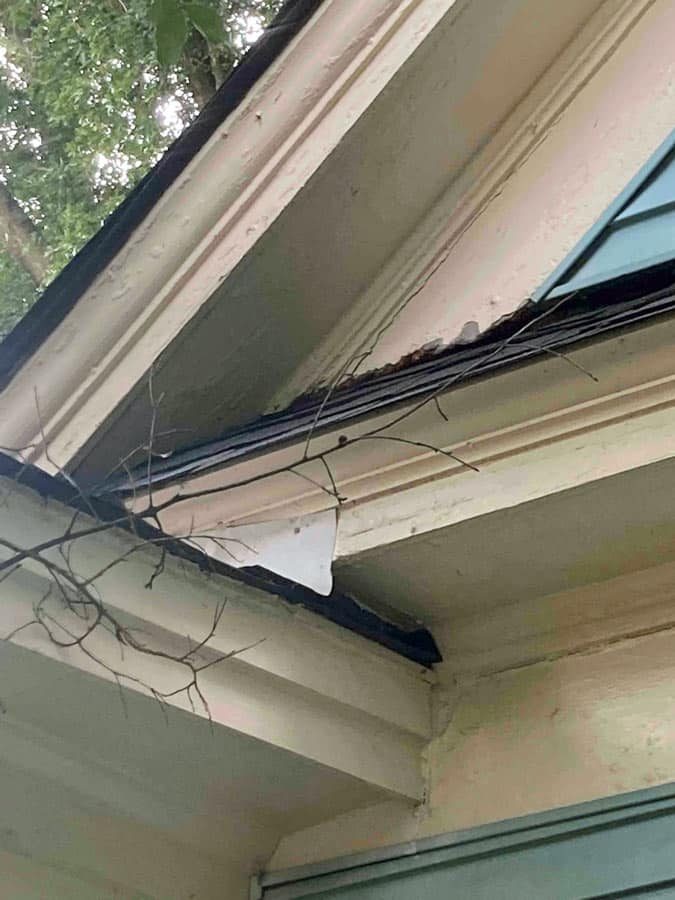
Hangers decide whether the run stays on the house. Old spike-and-ferrule gutters work loose as the fascia ages and the spike backs out a little each freeze-thaw cycle. Hidden hangers screw into solid framing behind the fascia and hold far better. If the fascia board itself has gone soft, and on anything that has been overflowing for years it often has, the board gets replaced first. Hanging new aluminum on rotten wood is a callback waiting to happen.
Pitch is small and unforgiving: a slight consistent fall toward each outlet, enough to drain, not so much that it reads from the street. Inside corners on a complex roof are where two planes dump into a single trough, and those are the first spots to overflow when outlet placement is lazy.
The last piece is where the water goes. A downspout ending at the foundation has concentrated an entire roof slope into one spot beside your basement wall. Extensions, buried drain lines or splash blocks routing well away from the house are the difference between a gutter system and an expensive decoration, and with the clay soils around this metro that is a foundation question, not a roofing one.
Gutters on St. Louis homes: big trees, brick and heavy downpours
Gutters in St. Louis work harder than the brochures suggest. Mature oaks, maples and sweetgums shade older neighborhoods like Kirkwood, Webster Groves and University City and drop leaves, seed pods and twigs that clog gutters several times a year. Summer thunderstorms can dump an inch of rain in under an hour, which overwhelms undersized gutters even when they are clean.
Basements raise the stakes. Many St. Louis homes have them, and the most common cause of a wet basement is roof water dumped right beside the foundation. We size downspouts to the roof area they drain and extend them well away from the house.
For most homes the choice comes down to 5-inch or 6-inch seamless aluminum. Six-inch gutters with oversized downspouts handle more water and clog less, and we often recommend them for steep roofs, long runs and heavy tree cover. Seamless gutters are formed on site to the exact length of each run, which leaves far fewer joints to leak.
On older brick homes we check the fascia board before hanging anything new. Years of overflowing gutters often rot it, and new gutters need solid wood to hold onto.
Seamless Gutters questions
What proves the damage is real and not a sales tactic?
What does seamless gutters cost in St. Louis?
It depends on linear footage, five or six inch, the number of downspouts and corners, and whether fascia repair is needed behind the old gutters. We measure before quoting.
Do you offer financing?
We do. Gutters are frequently done alongside a roof, and financing the two together usually makes more sense than separating them.
How soon can you start?
Gutter work schedules faster than roofing since it is a shorter job. Done alongside a roof replacement, it happens as part of that schedule.
Will insurance pay for this?
Storm-damaged gutters from a dated event are usually claimable along with the roof. Sagging from age, debris or ice is maintenance rather than a claim.
Should I get 5-inch or 6-inch gutters?
Five-inch gutters work on many homes. Six-inch gutters carry more water and clog less, so they are a better fit for steep roofs, large roof areas and lots of trees.
Do you install gutter guards?
Yes. Gutter guards cut down on clogging under heavy tree cover. We install them with new gutters or on existing gutters that are in good condition.
Should I replace my gutters when I replace my roof?
It often makes sense. New drip edge and gutters go together cleanly, and doing both at once avoids disturbing a brand-new roof edge later.
Free seamless gutters estimate
Fill this out and we'll call you back. If you have an active leak, phone us instead so we can get moving sooner.
Need A Roofer In St. Louis?
One free inspection replaces a week of guessing. Photos of the real condition and a written price, no obligation.