
Flat and Low-Slope Roofing in St. Louis, at a glance
The work includes single-ply TPO and PVC membrane. Someone answers the phone at (314) 429-6000 at any hour.
What tells us it's time for flat roofing
- Ponding water that doesn't drain within two days
- Blisters or bubbles in the membrane
- Open or lifting seams
- Leaks near HVAC curbs
- Gravel or old built-up roofing at end of life
What you're paying for with flat roofing
What's included: single-ply TPO and PVC membrane, modified bitumen where heat welding is impractical, tapered insulation to move water, and heat-welded seams with proper terminations at every edge and curb.
Should the tear-off expose rot in the decking, we stop and show you before replacing a single board. No surprise line items appearing on the final invoice.
Where we do this work
We cover the metro on both sides of the river - St. Louis City and County, St. Charles County, Jefferson County, and Madison and St. Clair County in Illinois. Offices in Maryland Heights, Chesterfield, Festus and Edwardsville.
Related pages
Hazelwood roofing
Local conditions and what we find on roofs there.
Every city we cover
The full metro on both sides of the river.
How the job runs
From the first call to the magnet sweep at the end.
Why low-slope roofs fail here, and what actually fixes them
Flat roofs do not fail because they are flat. They fail from water with nowhere to go and details that were never designed.
First the vocabulary, because it changes the approach: nothing is truly flat. Low-slope means under roughly three-in-twelve, and below that pitch water does not shed fast enough for shingles to work. Shingles rely on gravity and overlap, so put them on a two-in-twelve porch roof and wind-driven rain will push water up under the courses. A good share of the low-slope work we do in this metro is correcting exactly that: a porch, an addition or a dormer tie-in that got shingled because the rest of the house was.
Ponding is the core problem. Water standing beyond about two days after rain means either insufficient slope or blocked drainage, and standing water will find any marginal seam, magnify UV damage and add real structural load. The fix is sometimes as simple as clearing drains and scuppers, and sometimes it means tapered insulation to build fall into a deck framed dead level.
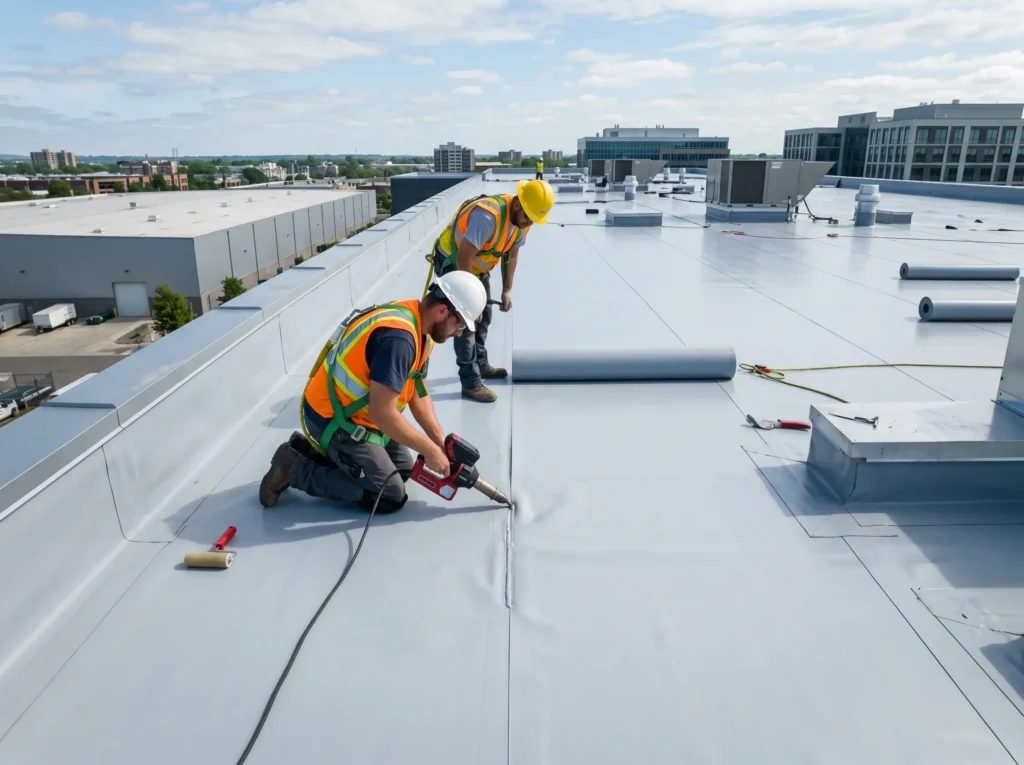
Seams and terminations are where membranes actually let go. On single-ply TPO and PVC the seams are heat-welded, and a properly welded seam is stronger than the sheet itself. What fails is the perimeter and the transitions, where the membrane turns up a parapet wall, terminates under a coping cap, or wraps an HVAC curb. Those need mechanical termination and counterflashing, not adhesive.
Blisters and bubbles usually mean moisture trapped in the assembly, often from an earlier repair laid over a wet substrate. Covering wet insulation seals the problem in, and the new roof then fails from underneath on somebody else's schedule. If we open a section and find saturated insulation, it comes out.
Older buildings here still carry gravel-surfaced built-up roofing, layers of felt and asphalt with stone on top. At end of life it can be torn off to the deck or, where the assembly is sound and dry, recovered. Which one is right is a judgment we make after opening it up, and we will show you what is under there before committing either way.
Flat and Low-Slope Roofing questions
Will insurance pay for this?
If the damage came from a dated storm event, usually yes. Ponding, age and seam fatigue are maintenance, not a claim, and we will tell you which one you have.
Are your crews employees or subcontractors?
Our own crews. Low-slope work is a different trade from shingles, and the crews who do it here are trained and certified on the specific membrane systems we install.
What happens to my yard and landscaping?
Do I need to be home?
Not for the work itself. Low-slope work happens entirely on the roof, and we would like you there for the walkthrough at the end.
How far out do you travel?
Free flat roofing estimate
Fill this out and we'll call you back. Leaking right now? Skip the form and call so we can move faster.
Need A Roofer In St. Louis?
One free inspection replaces a week of guessing. Photos of the real condition and a written price, no obligation.