
TPO roofing, at a glance
TPO is a white or light-colored single-ply sheet whose seams are welded together with hot air, so the joints become part of the membrane instead of relying on glue or tape. It reflects summer sun, which helps buildings with large roof areas stay cooler. Call (314) 429-6000 for a free flat roof inspection.
How a TPO roof goes on
The membrane is only part of the system. What goes under it matters as much.
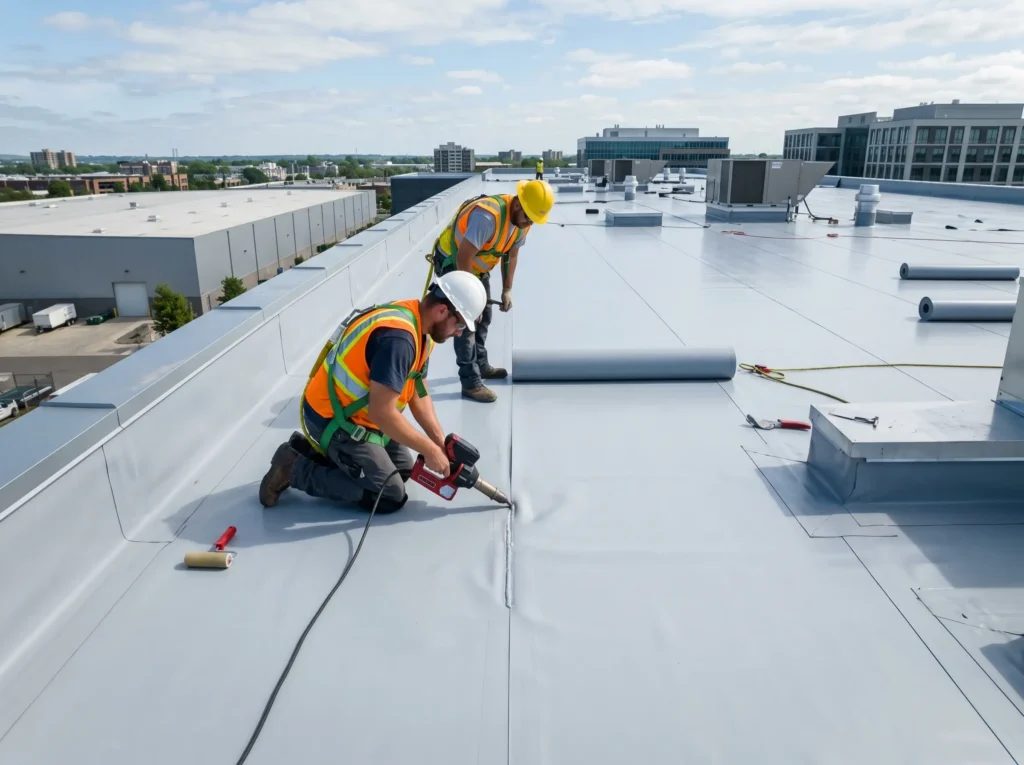
A TPO installation starts with the existing roof. Depending on its condition, we either tear it off or, where codes and the deck allow, install over it with a cover board. Rigid insulation is laid next, often tapered to move water toward drains. The membrane is then mechanically fastened through the insulation into the deck or fully adhered with bonding adhesive.
Seams are welded with a hot-air welder and probed by hand to check for gaps. Corners, curbs, pipes and drains get pre-formed or field-fabricated flashing made from the same material, also welded. Along the edges we install metal edge or coping that holds the membrane in place in high winds. The result is a roof with few weak points, provided the details are done right.
Where TPO fits
We install TPO on commercial and residential low-slope roofs around the metro.
Commercial buildings
Offices, retail, warehouses and churches with large flat roof areas.
Residential flat roofs
Porch roofs, garages and rear additions too flat for shingles.
City rowhouses
Low-slope rear roofs behind parapet walls.
HVAC-heavy roofs
Curbs and equipment supports flashed with welded TPO details.
Re-roof over existing
Where allowed, a cover board and new membrane over a sound existing roof.
Repairs and patches
Punctures and open seams repaired by welding new TPO over the damage.
TPO compared with other flat roof options
St. Louis flat roofs are also commonly covered with EPDM, a black rubber membrane, or modified bitumen, an asphalt-based roll roofing. EPDM has a long track record and is easy to patch, but its seams are glued or taped and it absorbs heat. Modified bitumen holds up well to foot traffic but is heavier and its seams depend on torch or adhesive work.
TPO's welded seams and reflective surface make it a common choice for buildings that cool large spaces in the summer. We will tell you which material makes sense for your roof and budget, and we install all three.
- Welded seams checked by hand after installation
- Tapered insulation where drainage needs help
- Matched TPO flashing at curbs, pipes and drains
- Metal edge and coping secured for wind
TPO roofing at a glance
| Material | Thermoplastic polyolefin single-ply membrane |
|---|---|
| Color | White, light gray or tan |
| Seams | Hot-air welded |
| Attachment | Mechanically fastened or fully adhered |
| Best for | Flat and low-slope roofs, commercial and residential |
| Service area | St. Louis City, St. Louis County, St. Charles County, Metro East |
| Installer | John Beal Roofing, family-run since 1947 |
Our process for a TPO project
Free flat roof inspection
We check the existing roof, drains, insulation and deck, and take core samples when needed.
Written proposal
Tear-off or re-cover, insulation, attachment method and details are spelled out.
Install
Crews work in sections so the building stays dry, with daily cleanup.
Final review
Seams probed, details checked and the roof walked with you or your facilities manager.
John Beal Roofing is a third-generation family company founded in 1947. We hold an A+ BBB rating, Owens Corning Platinum Preferred status for our shingle work, and a place on Roofing Contractor Magazine's Top 100. Our installation work comes with a lifetime workmanship warranty.
TPO roofing questions
Can TPO go on a house?
Can you put TPO over my existing flat roof?
Does a white roof really lower cooling costs?
Can TPO be repaired?
Is the flat roof inspection free?
Free flat roof inspection
Fill this out and we'll call you back. If water is coming in right now, phone us instead so we can move faster.
Flat Roof Giving You Trouble?
We will inspect it for free and tell you whether it needs a repair, a re-cover or a new system.